Writing & SEO
LanguageTool
Our free LanguageTool browser test found spelling and agreement errors, including an issue revealed after another correction. Read the exact examples and limitations.
Research summary
Our free LanguageTool browser test found spelling and agreement errors, including an issue revealed after another correction. Read the exact examples and limitations.
LanguageTool identified three initial issues in our deliberately flawed sample, then exposed another agreement problem after an earlier correction. That made the checker useful as an interactive editing aid. It also showed why a displayed error count is not a count of every problem in a sentence.
Test setup and exact input
Tested on 16 November 2026 by AI Product Reviews automated browser test. This is a limited hands-on automated check of the public, free browser interface without signing in. The interface did not expose an exact software or model version. It is not a long-term human review or an independent accuracy benchmark.
We used the LanguageTool homepage checker with English selected, the British flag displayed and Picky Mode off. The interface showed a 2,000-character limit in this session. No extension or paid feature was tested.
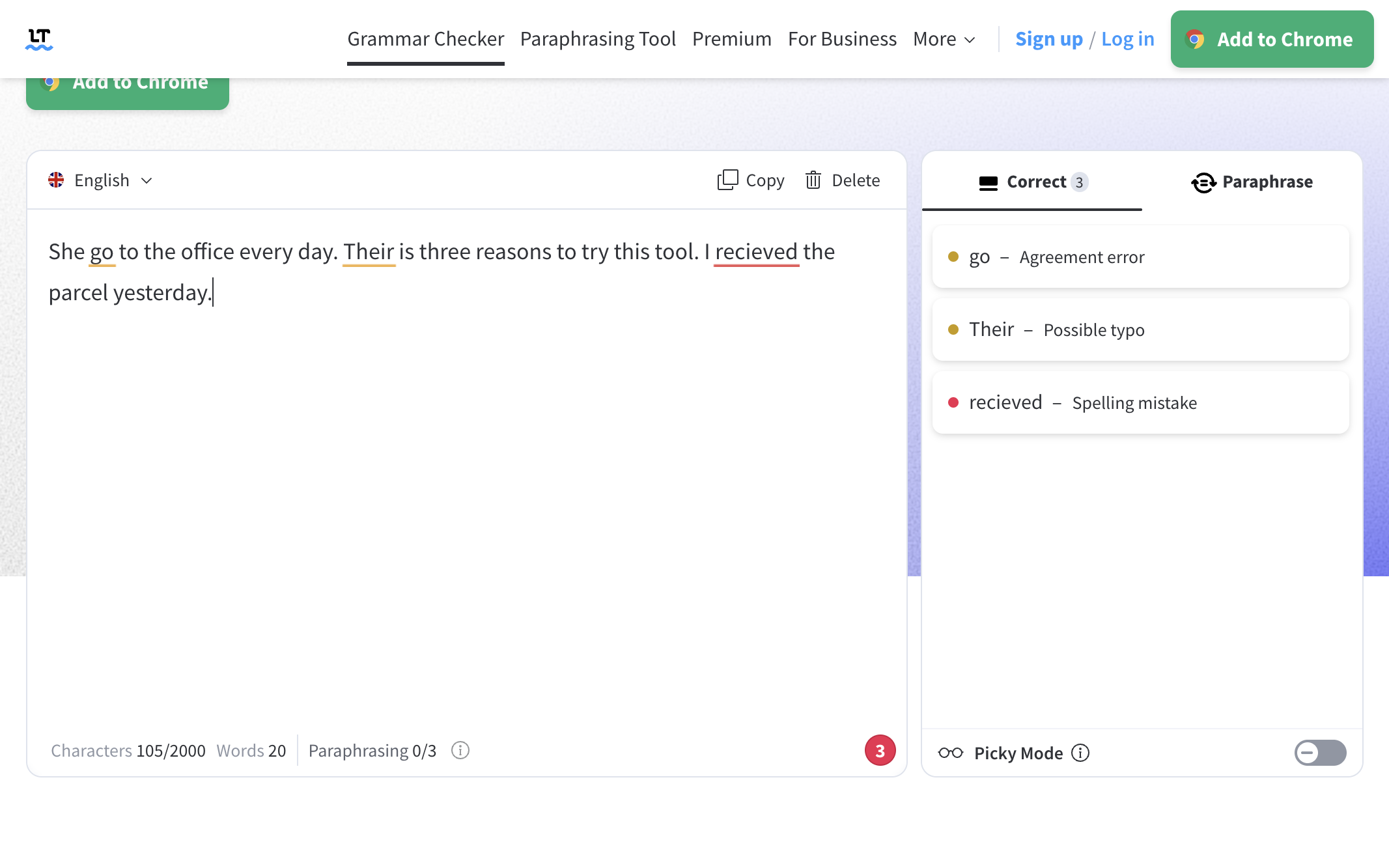
Input: “She go to the office every day. Their is three reasons to try this tool. I recieved the parcel yesterday.”
The checker displayed 20 words and 105 characters. Its first pass highlighted “go” as an agreement error, “Their” as a possible typo and “recieved” as a spelling mistake.
Inspecting the suggestions
Opening the agreement card offered “goes” and “went”. Both are grammatical possibilities, but the surrounding “every day” matters when choosing the intended tense. The typo card suggested “There”. After applying “goes” and “There”, the checker identified “There is three reasons” and offered “There are three reasons”. The useful workflow is therefore to recheck the sentence after accepting an edit.
The spelling card offered both “received” and “relieved”. These are different meanings, even though both are real words. A reviewer must choose the word intended by the author rather than accept a suggestion because it removes an underline. We do not treat these suggestions as an automatic guarantee of meaning preservation.
For a clean control, we entered: “The parcel arrived yesterday. Please confirm receipt before Friday.” The interface reported “Splendid! No errors were found.” This control result was observed in the browser; the surviving screenshot above documents the planted-error case. It is a small control, not evidence that the checker never overcorrects.
Who should try it
Someone proofreading short English messages can inspect concrete suggestions and keep control of the final wording. Our test supports that narrow use. It does not establish performance on academic prose, multilingual documents, a browser extension or a whole team’s workflow. We did not test plagiarism checks, factual accuracy or paid style advice, and current subscription prices were not verified.
For text that first needs translation, see our separate DeepL test. Its translation output and LanguageTool’s grammar suggestions solve different parts of a writing workflow; neither test establishes that factual claims are true.
The strongest takeaway is procedural: check the explanations, apply the intended correction and read the complete sentence again. In this session an additional grammar issue appeared only after an earlier typo was fixed. That is a useful reason to keep the editing loop open rather than equate an initial three flags with a complete diagnosis.
Download the exact test record.